The established merits of emerging managers in private markets
18 February 2025
 7 minute read


When allocating capital, investors are naturally drawn to managers with established brands and proven track records. The attractions of a firm with deep pockets, broad networks to source deals and experience of navigating different market conditions are hard to resist.
What of managers who have only just started running their own funds? Emerging managers have typically completed only a handful of fundraises, or have assets under management of no more than a few hundred million. They are relative newcomers without the same advantages of scale, and which may also lack the institutional grade infrastructure. So why should investors consider them?
The first and most obvious reason is that to omit emerging managers from a portfolio is to pass up on some of the best opportunities in the market. Between 2004 and 2016, Cambridge Associates ranked the top ten performing venture capital (VC) funds each year by vintage. Across that period, 53% of these funds were run by emerging managers operating either their first or second fund (including third and fourth funds, that figure rose to 73%). Outperformance has also stemmed from smaller funds which will typically be operated by emerging managers: from 2013-22, 91% of the top ten VC funds annually were smaller than $250m, and 73% were less than $100m in size.
A high performing fund may also be the indicator of a manager with significant growth ahead of them. Just as an investor in the S&P 500 will never be a full beneficiary of the next Amazon or Alphabet, the allocator who spurns emerging managers will negate their chances of getting in on the ground floor with the future equivalents of firms such as Andreesen Horowitz and Sequoia Capital, which have become household names.
The appeal of emerging managers
While thousands of VC firms operate in the US, more than half of the $71bn in fundraising last year flowed to just nine of them. As the big get bigger, there are advantages to being a VC that can pursue the nimble, differentiated approach that has traditionally been the source of high returns. In turn, there are good reasons for investors to consider allocating to these smaller players.
First, it is a near certainty that an emerging manager will be highly invested in their own fund, to a greater extent than the GP of an established fund. Their success is their LPs’ success more so than with large managers, where compensation is more aligned to management fees derived from large AUM pools.
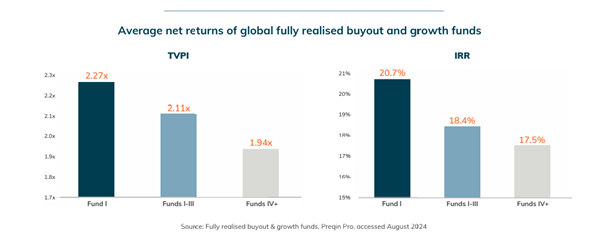
For an emerging manager to prosper, they need to outperform the benchmark for their investors and meet the terms of performance fees. Never is that requirement greater than when they are building their track record from scratch. That may help to explain why managers appear to deliver the best returns with the first fund they launch: among fully realised buyout and growth private equity funds, the average Fund I delivered a 20.7% IRR compared to 18.4% for Funds I-III and 17.5% for Funds IV and beyond.
The incentive to deliver alpha also fuels another benefit: an appetite for innovation. In search of the best returns, emerging managers often embrace specialised markets, emerging sectors or one-off opportunities which might not sit comfortably within the investment mandate of a larger, more generalist manager. Equally, with smaller pools of capital they will make fewer investments and must be highly disciplined about them. For LPs, the net benefit is diversification, bringing assets and strategies into their portfolios that they are unlikely to access through established managers.
Finally, emerging managers think and act like challengers. They can move faster and more flexibly, be opportunistic about deals, and they have the ability to respond smartly to changing market conditions. With smaller portfolios and fewer investors, they dedicate more time both to supporting the companies they invest in and servicing the needs of individual LPs.
For investors, the simple truth is that their money is more valuable to an emerging manager, and their status as an LP will be more significant. As well as more attentive client service, this may also lead to co-investment opportunities in attractive deals, or priority allocation in future funds – leading to longer term advantages.
The state of emerging managers
For all these advantages, emerging managers must still fight for their niche within the investing industry. In VC especially, allocation is highly concentrated: the vast majority of dollars go into a very small proportion of funds. In the first three quarters of 2022, for example, 62% of all capital invested in VC was allocated to just 6% of total funds. In capital terms at least, the winners keep winning, leaving relatively little space for newcomers.
This is part of a well established trend. According to Pitchbook, the appetite for emerging managers has been shrinking throughout this century. As a share of total funds, emerging managers peaked in 2000 at 70.2%, and in terms of share of funds raised, in 2002 at 45.8%. Both figures have seen a steady decline ever since: in 2024, emerging managers accounted for 44.7% of all funds and just 15.4% of funds raised.
Emerging managers may represent a smaller share of the industry than they once did, but that does not mean there is any lack of appetite from new managers to launch funds. Indeed, recent years have seen a mini-resurgence: in the first three quarters of 2024, 37% of fund launches were attributed to first-time managers. In 2023, over 200 first-time funds were introduced, up by more than a fifth on the previous year.
The supply of emerging managers is matched by a demand among allocators for the alpha generation and diversification that they are well placed to offer. One survey of LPs found that they invest in emerging managers in search of higher alpha (88%) or unique investment strategies (70%) – suggesting that for some investors, an emerging manager fund is the kind of risk-reward proposition they wish to make space for in their portfolio.
The future for emerging managers
What then is the future for emerging managers, as private markets look to recover from the trough that followed the bull market of 2020-21?
With a robust supply of emerging managers, the question is whether investors are willing to undertake the work required to allocate to them. There is no escaping that the due diligence to invest in emerging managers is thoroughgoing and time-consuming. Allocators must be willing to turn over lots of rocks, and able to spread their capital among a sufficient number of prospects that they are diversified, but not so many that the outperformance of the winners is diluted.
The good news for emerging managers is that investors appear increasingly willing to undertake that work, as the price of accessing the distinctive benefits that their funds offer. One recent pulse check of LPs found that a majority (57%) are looking to work with a wider base of managers this year, and almost half will specifically consider allocating to emerging managers in 2025. Another study showed that existing investors are minded either to increase (47%) or maintain (53%) their allocation to emerging manager funds.
As LPs look to navigate changing market conditions, access alternative asset classes, and bring diversification to their portfolios, emerging managers can take them to corners of the market that their established peers cannot. The promise of a point of difference, and the potential of outperformance that comes with it, means that emerging managers will remain a serious consideration for many, and an important component of mature, diversified private market portfolios. Investors recognise that, for all the dominance of large and established funds, there are advantages that only emerging managers can offer, investments only they can make, and alpha only they are shaped and sized to unlock.


